
 All Products Waveform Monoradial


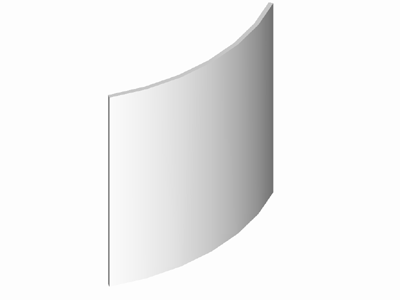 Overhead canopies
are used in auditoriums to blend the direct and reflected sound and
either increase intelligibility or enhance musical clarity and
intimacy. Typically canopy arrays are used instead of a solid ceiling,
to provide needed early reflections, while maintaining a desired
reverberation time. Often, flat panel arrays are used for economy.
However, flat panel arrays can potentially provide non-uniform
scattered sound, due to the lack of scattering from gaps between the
panels. One approach to help reduce this problem is to utilize shaping
to provide diffusion. The simplest approach is a single curvature panel
called the Monoradial™. The Monoradial™ is
typically used to provide longitudinal (front-back) scattering to help
minimize the problems from flat panels. RPG offers the
Monoradial™ in Class A Glass Reinforced Gypsum and wood.
Overhead canopies
are used in auditoriums to blend the direct and reflected sound and
either increase intelligibility or enhance musical clarity and
intimacy. Typically canopy arrays are used instead of a solid ceiling,
to provide needed early reflections, while maintaining a desired
reverberation time. Often, flat panel arrays are used for economy.
However, flat panel arrays can potentially provide non-uniform
scattered sound, due to the lack of scattering from gaps between the
panels. One approach to help reduce this problem is to utilize shaping
to provide diffusion. The simplest approach is a single curvature panel
called the Monoradial™. The Monoradial™ is
typically used to provide longitudinal (front-back) scattering to help
minimize the problems from flat panels. RPG offers the
Monoradial™ in Class A Glass Reinforced Gypsum and wood.
Problem
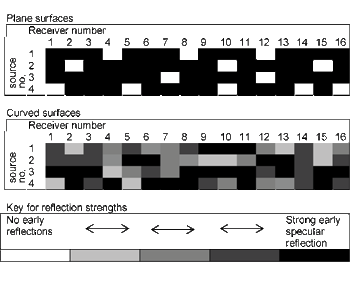
The figure shows coverage plot simulations from 4 sources to 16
receivers comparing spaced arrays of flat panels and curved panels. In
the upper illustration, typical coverage holes are apparent. These
coverage problems, which are due to the spaces between the panels,
result when there is no ceiling panel to specularly reflect a source
ray to a receiver.
Solution
A simple conventional solution is to curve the panel in one direction
forming an arc. In the middle illustration, it is apparent that the
curve introduces scattering into non specular directions, partially
solving the coverage problem. The level of the reflections is
illustrated in the bottom graphic.
Diffusion
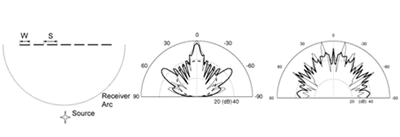
In the left illustration, we show an array of flat panels 1m wide and
1.25 m apart, along with the source and the receiver arc. In the middle
illustration, we show the far field response along the receiver arc for
this flat panel array. Periodicity lobing at +/- 53 degrees at mid
frequencies (dark line) is evident. High frequencies (light line) are
purely specular and low frequencies (dashed line) are omnidirectional
for this panel size. On the right, the response for an array of
semicylinders of the same size is shown at mid frequency (light line),
illustrating the dispersing effect of the semicylinders. Periodicity
lobing, however, is still present. The response of an aperiodic
semicylinder array is also shown (dark line) to illustrate the
improvement modulation provides.
Installation
Installation is simple using integral metal hair pin connectors. Simply
attach suitable airline cable for dead hung installation.
Specifications
Product Option Sheet
Waveform® Monoradial panels are available in
4’x8’x9” and
4’x8’x12” sizes. Three surface weight
options are available 3 lb/sf ¼” GRG, 4 lb/sf 1
5/8” GRG/Honeycomb/GRG (GHG), and 5 lb/sf GHG. Panels can be
factory or field painted. Aperiodic arrays can be formed using two
different depths in an optimal binary sequence supplied by RPG.
Features
Benefits


